


Quick verdict: Buy the refurbished iPhone 12 Pro Max if you want the lowest price (from around $334 in 2026) and do not need ProMotion, the 48MP camera, or Dynamic Island. Buy the iPhone 14 Pro Max (from around $457) if you want a sharper camera, a smoother 120Hz display, longer battery life, and more years of iOS updates. The gap is roughly $123.
Choosing between two of Apple's top-tier Pro Max models is rarely straightforward, especially when both can be found at compelling refurbished prices. The iPhone 12 Pro Max was a landmark device when it launched in late 2020, and the iPhone 14 Pro Max raised the bar again in 2022. Both still run the latest iOS in 2026, so the real question is whether the 14 Pro Max upgrades justify the higher price for your needs.
This guide breaks down every meaningful difference so you can decide with confidence. Prices below are refurbished starting prices on RefurbMe and move week to week, so check the live figures before you buy.
Table of contents
- Reasons to choose the iPhone 12 Pro Max
- Reasons to choose the iPhone 14 Pro Max
- iPhone 12 Pro Max vs. iPhone 14 Pro Max: At a glance
- iPhone 12 Pro Max vs. iPhone 14 Pro Max: All the differences
- FAQ
- Conclusion
Reasons to choose the iPhone 12 Pro Max
- Significantly more affordable: refurbished prices start at around $334 in 2026.
- Still delivers strong everyday performance with the A14 Bionic chip.
- Capable triple-lens camera system with LiDAR scanner.
- Same 6.7-inch Super Retina XDR display size as the 14 Pro Max.
- Runs the latest iOS, so you still get current Apple software features.
- A smart pick if budget is the priority and you do not need ProMotion or Dynamic Island.
Reasons to choose the iPhone 14 Pro Max
- Faster A16 Bionic chip with improved power efficiency.
- 48MP main camera for sharper detail and better low-light photography.
- ProMotion display with 1-120Hz adaptive refresh rate for smoother scrolling.
- Dynamic Island replaces the notch and adds an interactive notification hub.
- Longer battery life: up to 29 hours of video playback versus 20 hours.
- Always-On display keeps the time and key widgets visible without waking the screen.
- Safety features like Crash Detection and Emergency SOS via Satellite.
- Several more years of iOS support, useful if you plan to keep the phone past 2027.
- Refurbished prices start at around $457, a modest step up for meaningfully more phone.
iPhone 12 Pro Max vs. iPhone 14 Pro Max: At a glance
In short, the iPhone 14 Pro Max wins on camera (48MP vs 12MP), display (120Hz ProMotion vs 60Hz), and battery (up to 29 hours of video vs 20). The iPhone 12 Pro Max wins on price, starting around $123 cheaper refurbished. Both run the latest iOS in 2026, so neither is left behind on software today.
| Feature | iPhone 12 Pro Max | iPhone 14 Pro Max |
|---|---|---|
| Release date | November 13, 2020 | September 16, 2022 |
| Display | 6.7" Super Retina XDR OLED, 60Hz | 6.7" Super Retina XDR OLED, ProMotion 1-120Hz, Dynamic Island, Always-On |
| Processor | A14 Bionic (5nm) | A16 Bionic (4nm) |
| RAM | 6GB | 6GB |
| Storage | 128GB, 256GB, 512GB | 128GB, 256GB, 512GB, 1TB |
| Rear cameras | 12MP wide, 12MP telephoto, 12MP ultrawide, LiDAR scanner | 48MP wide, 12MP telephoto, 12MP ultrawide, LiDAR scanner |
| Front camera | 12MP TrueDepth | 12MP TrueDepth with autofocus |
| Battery capacity | 3,687 mAh (up to 20 hrs video) | 4,323 mAh (up to 29 hrs video) |
| Design | Stainless steel frame, notch | Stainless steel frame, Dynamic Island |
| Water resistance | IP68 | IP68 |
| Colors | Graphite, silver, gold, Pacific Blue | Space black, silver, gold, deep purple |
| Max OS support | Runs latest iOS in 2026, supported through about 2027 | Runs latest iOS in 2026, supported through about 2029 |
| 5G | Yes | Yes |
| Refurbished price (2026) | From | From |
iPhone 12 Pro Max vs. iPhone 14 Pro Max: All the differences
While the iPhone 12 Pro Max remains a capable device, the iPhone 14 Pro Max brings several meaningful upgrades. Here is a detailed look at each area.
Display and design
Both phones share the same 6.7-inch Super Retina XDR OLED panel, delivering rich colors and deep blacks. But the iPhone 14 Pro Max adds three notable improvements:
- ProMotion: The 14 Pro Max uses a 1-120Hz adaptive refresh rate. The screen ramps up to 120Hz for smooth scrolling and gaming, then drops to as low as 1Hz during static content to save power. The 12 Pro Max is locked at 60Hz throughout.
- Dynamic Island: Apple replaced the notch with a pill-shaped cutout that doubles as an interactive element. It surfaces live activities such as music playback, timers, navigation, and notifications without interrupting what you are doing.
- Always-On display: The 14 Pro Max can show the time, date, and widgets even when the screen is technically off, a feature absent from the 12 Pro Max entirely.
- Brightness: The 14 Pro Max reaches up to 2,000 nits peak brightness outdoors and about 1,600 nits for HDR content, compared to 800 nits typical and 1,200 nits HDR peak on the 12 Pro Max.

iPhone 14 Pro Max with Dynamic Island
Resolution differences are marginal: 2,778 x 1,284 pixels on the 12 Pro Max versus 2,796 x 1,290 on the 14 Pro Max. You will not notice that in daily use.
Color options differ between generations. The 12 Pro Max came in graphite, silver, gold, and Pacific Blue. The 14 Pro Max offered space black, silver, gold, and deep purple.
Performance
The iPhone 12 Pro Max uses Apple's A14 Bionic chip, built on a 5nm process. It has a 6-core CPU (2 performance cores, 4 efficiency cores), a 4-core GPU, and a 16-core Neural Engine. At launch it was the fastest chip in any smartphone, and it still handles everyday tasks, gaming, and 4K video editing without complaint.
The iPhone 14 Pro Max steps up to the A16 Bionic, built on a 4nm process. The CPU layout is similar at 6 cores, but the architecture is more refined. The GPU grows to 5 cores, and the Neural Engine runs faster machine learning workloads. In benchmarks the A16 scores roughly 15-20 percent higher in multi-core tests, and the efficiency gains translate to real-world battery savings.
In practical use, both chips feel smooth for social media, streaming, and productivity. The gap becomes clearer in sustained workloads: editing long ProRes video clips, running complex AR applications, or processing large photo libraries. If those tasks matter to you, the 14 Pro Max has a clear edge. For most people, the A14 in the 12 Pro Max is still more than adequate.
Cameras
Camera quality is one of the strongest arguments for upgrading to the 14 Pro Max:
- Main sensor: The 14 Pro Max jumps from a 12MP sensor to a 48MP sensor on the primary wide lens. This delivers noticeably more detail, better crops, and improved low-light output. The 12 Pro Max holds up well in good light but shows its limits in challenging conditions.
- Macro photography: The 14 Pro Max unlocks macro mode through its ultrawide lens, letting you get as close as 2cm for detailed close-up shots. The 12 Pro Max does not support this.
- Photonic Engine: Apple's computational photography pipeline on the 14 Pro Max uses the A16 to process more image data before compression, improving color accuracy and dynamic range across all lenses.
- Video stabilization: The 14 Pro Max adds Action Mode, which provides stabilization close to a gimbal for handheld video. The 12 Pro Max has Optical Image Stabilization but nothing comparable to Action Mode.
- Zoom range: The 14 Pro Max offers four optical-quality zoom levels from 0.5x to 3x. The 12 Pro Max covers a similar range but with less flexibility between steps.
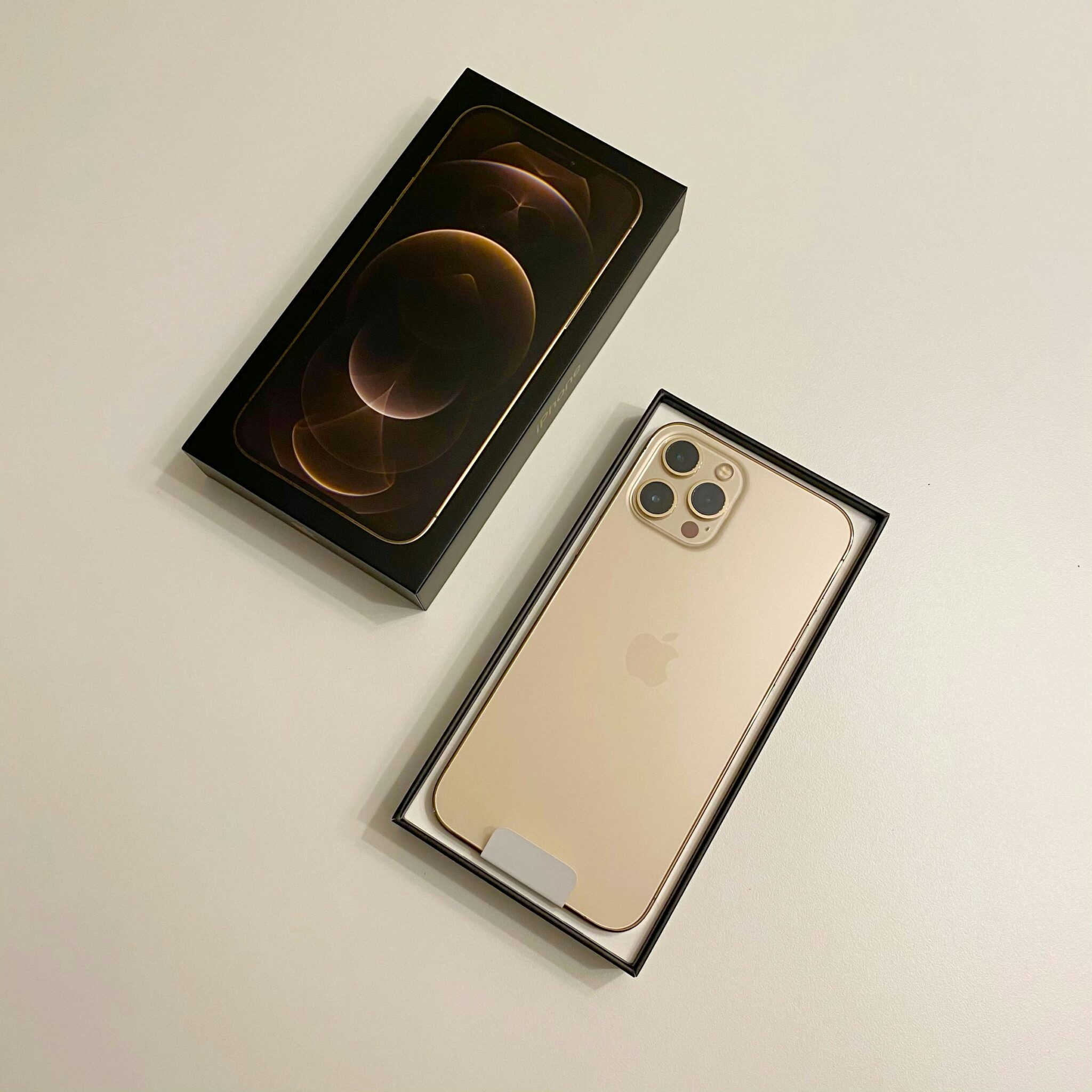
Gold iPhone 12 Pro Max
Both phones include a LiDAR scanner, which helps with AR apps and autofocus in low light. That is a strong point the 12 Pro Max retains.
Battery life
Apple rates the iPhone 12 Pro Max at up to 20 hours of video playback. The iPhone 14 Pro Max reaches up to 29 hours, a significant jump driven by both the larger 4,323 mAh battery and the A16's efficiency improvements. The Always-On display adds a small drain on the 14 Pro Max, but the overall battery advantage is still substantial.
In real use, the 12 Pro Max comfortably gets through a full day for most people. The 14 Pro Max handles heavier usage patterns and still ends the day with charge to spare. If you are a power user who relies on navigation, video, or mobile hotspot for long stretches, the 14 Pro Max is the more dependable choice.
Software and longevity
Both phones run the latest version of iOS in 2026, so neither is stuck on old software today. The difference is how much runway is left. The iPhone 12 Pro Max, a 2020 device, is expected to keep getting major updates through roughly 2027, while the iPhone 14 Pro Max should continue receiving them into about 2029.
This matters for security patches as well as new features. If you intend to keep the phone for three or more years, the 14 Pro Max has the clear advantage in software longevity. If you replace your phone more often, both are well supported for now.
FAQ
Conclusion
The iPhone 12 Pro Max remains a solid choice if your budget is the deciding factor. Refurbished prices starting around $334 make it one of the most affordable ways to own a large-screen Apple flagship with 5G, LiDAR, and a triple-lens camera. It still runs the latest iOS in 2026, though its update runway is shorter, expected to last through about 2027.
The iPhone 14 Pro Max justifies its higher starting price of around $457 with a better camera, a smoother ProMotion display, substantially longer battery life, and several more years of software support into roughly 2029. For most buyers who want a refurbished iPhone that will stay relevant well beyond 2027, it is the smarter pick.
If you are comparing other generations before deciding, see our guides on the iPhone 12 Pro Max vs. iPhone 13 Pro Max and the iPhone 13 Pro Max vs. iPhone 14 Pro Max.
RefurbMe compares prices from Back Market, Gazelle, Amazon Renewed, the Apple Store, and other trusted resellers in one place. You can browse current deals on both models below and filter by condition, storage, and carrier to find the right fit at the right price.
Explore more iPhone comparisons
Last updated: Jun 25, 2026 · First published: Mar 29, 2024